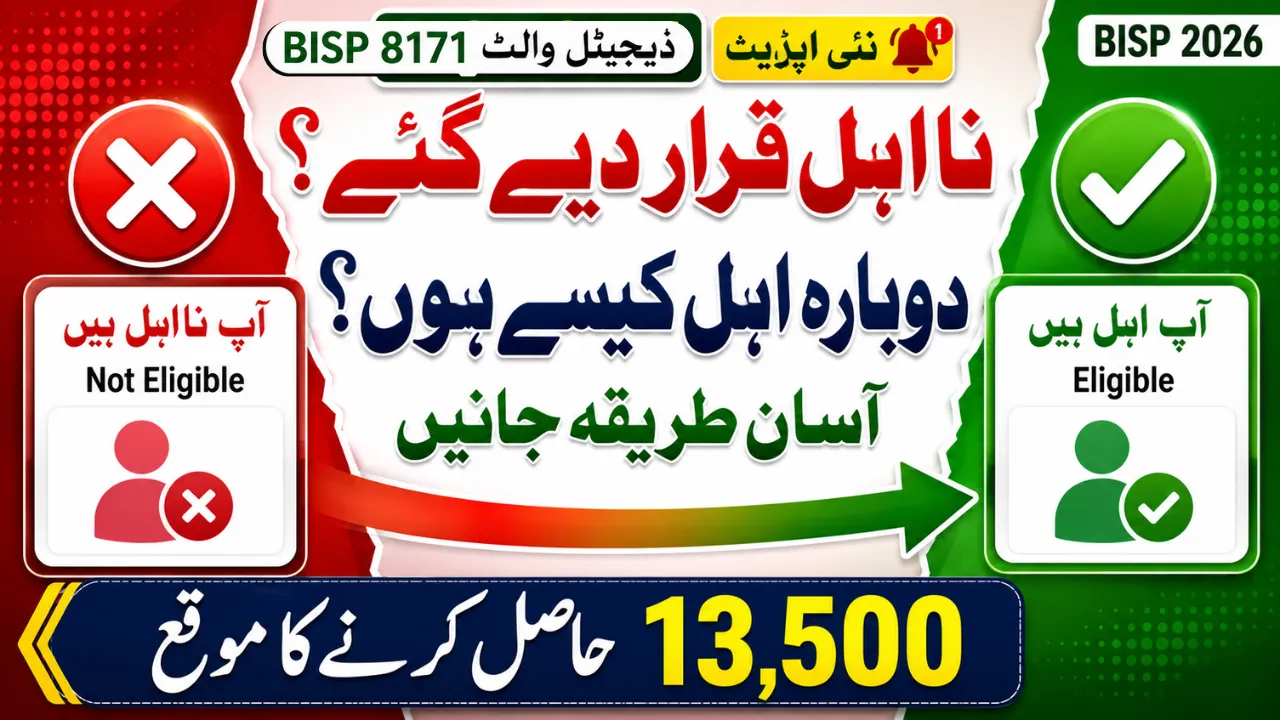
Millions of families across Pakistan depend on the Benazir Income Support Programme (BISP) for financial support. However, many applicants receive an ineligible status when checking their record through the 8171 system. Receiving this response does not always mean permanent disqualification. In many situations, eligibility can be restored after updating household information, completing verification requirements, or correcting outdated records.
This guide explains why applicants become ineligible, who can qualify for the Rs 13,500 payment, how eligibility assessments are conducted, and what actions can improve approval chances in 2026.
What Does BISP 8171 Ineligible Status Mean?
An ineligible status indicates that the information available in government databases does not currently meet the requirements for financial assistance under the Benazir Kafalat Program.
The eligibility system evaluates multiple factors, including:
- Household income level
- Poverty score assessment
- Family composition
- Employment status
- Property ownership records
- Vehicle registration details
- Utility consumption patterns
- NSER survey information
- NADRA verification data
When one or more indicators suggest that a household exceeds the program’s eligibility threshold, the application may be marked as ineligible.
Latest BISP Eligibility Criteria for Rs 13,500 Payment
Families seeking assistance should generally meet the following conditions:
- Belong to a low-income household
- Have a valid CNIC
- Complete NSER registration
- Maintain accurate family information
- Not hold government employment
- Not possess significant assets
- Meet the required poverty score benchmark
- Successfully pass verification checks
- below click to check css eligibility

Eligibility assessments are regularly updated to ensure that financial aid reaches households facing genuine economic hardship.
Main Reasons Applicants Become Ineligible
Understanding the causes of rejection can help applicants address issues before requesting re-evaluation.
Higher Household Income
The program prioritizes financially vulnerable families. If records indicate stable earnings above the approved threshold, the application may not qualify for assistance.

Government Employment
Households linked to serving government employees are often excluded because regular salaries are considered a source of financial stability.
Incorrect NSER Information
Outdated survey information remains one of the most common causes of ineligibility. Changes in family size, marital status, employment conditions, or residential details should be reported promptly.
Asset Ownership Records
Ownership of valuable assets may affect eligibility assessments. Verification systems cross-check information through multiple government databases.
Unverified Family Information
Applications with mismatched records between NADRA and NSER databases may remain under review or receive an ineligible status until discrepancies are resolved.
Incomplete Registration Details
Missing documentation or unfinished registration processes can delay approval decisions and affect eligibility outcomes.
Who Can Requalify After Becoming Ineligible?
Many families assume that disqualification is permanent, but this is not always true.
Applicants may become eligible again if:
- Household income decreases significantly
- Employment circumstances change
- Family conditions worsen financially
- Previous data contained errors
- NSER records are updated successfully
- Verification issues are resolved
The program periodically reviews beneficiary information, allowing deserving households another opportunity to qualify.
How the BISP Verification System Evaluates Applicants
Modern verification procedures use integrated databases to improve transparency and reduce errors.
Information may be reviewed through:
- NADRA records
- NSER survey data
- Family registration details
- Utility consumption information
- Socioeconomic indicators
- Household composition records
- Government employment databases
- Financial eligibility assessments
This integrated approach helps ensure that assistance reaches deserving beneficiaries while maintaining program integrity.
Steps to Qualify for Rs 13,500 Assistance
Applicants who receive an ineligible status should focus on improving the accuracy of their records and ensuring compliance with eligibility requirements.
Update Household Information
Families should ensure that all details submitted during registration accurately reflect their current circumstances.
Complete NSER Survey Verification
Participation in the latest survey process helps authorities reassess household conditions using updated information.
Resolve NADRA Record Issues
Incorrect personal details, family records, or identification information should be corrected immediately.
Maintain Accurate Contact Information
Updated mobile numbers and address information help applicants receive important notifications regarding verification and payments.
Submit Required Documentation
Providing complete supporting documents can reduce delays during eligibility reviews.
Request Reassessment When Circumstances Change
Applicants facing financial hardship after previous rejection may request a fresh evaluation based on their current situation.
BISP Reapplication Process for Previously Rejected Families
Families that no longer meet the reasons for rejection can seek reassessment.
The review process generally involves:
- Verification of CNIC information
- Household record evaluation
- Updated socioeconomic assessment
- NSER data review
- Eligibility recalculation
- Final approval determination
Successful reassessment may restore eligibility for future payment cycles.
Common Mistakes That Lead to BISP Rejection
Many applications face problems because of avoidable errors.
These include:
- Providing incomplete information
- Using outdated household records
- Ignoring verification notices
- Failing to update family changes
- Entering incorrect CNIC details
- Missing registration opportunities
- Not participating in NSER updates
Avoiding these issues can improve the likelihood of successful enrollment.
Benefits of Keeping Your BISP Record Updated
Regular updates offer several advantages:
- Faster verification decisions
- Reduced risk of rejection
- Improved record accuracy
- Better communication from authorities
- Higher chances of maintaining eligibility
- Smoother payment processing
Families should periodically review their registration information to ensure continued compliance.
How to Check BISP 8171 Eligibility Status
Applicants can verify their status through official channels using their CNIC information.
Status checks help determine whether:
- The application is under review
- Additional verification is required
- Payment has been approved
- Household information needs updating
- The applicant has become eligible again
Regular status monitoring helps families respond quickly to any verification requirements.
Important Documents That May Be Required
Keeping documents ready can speed up the review process.
Commonly requested records include:
- Original CNIC
- Family registration information
- Proof of residence
- Updated household details
- Supporting verification documents
Authorities may request additional information depending on individual circumstances.
Frequently Asked Questions
Can an ineligible applicant become eligible again?
Yes. Eligibility can change when household conditions, income levels, or verification records are updated.
Does updating NSER information improve approval chances?
Accurate and current NSER records help authorities assess a household’s actual financial condition.
Can data errors cause rejection?
Yes. Incorrect or outdated information may result in an ineligible status until corrections are completed.
How often should applicants verify their status?
Checking periodically helps applicants stay informed about verification requirements and eligibility updates.
Final Words
Receiving a BISP 8171 ineligible status is not necessarily the end of the process. Many households regain eligibility after correcting records, updating survey information, or completing verification requirements. The key is ensuring that all submitted information accurately reflects current financial conditions.
Families facing economic difficulties should keep their records updated, participate in verification activities, and monitor their status regularly. Accurate information and timely updates significantly improve the chances of qualifying for the Rs 13,500 BISP assistance payment and receiving continued support through future payment cycles.